
Human After All
Granit Xhaka knows why you don't love him, but he demands you respect him

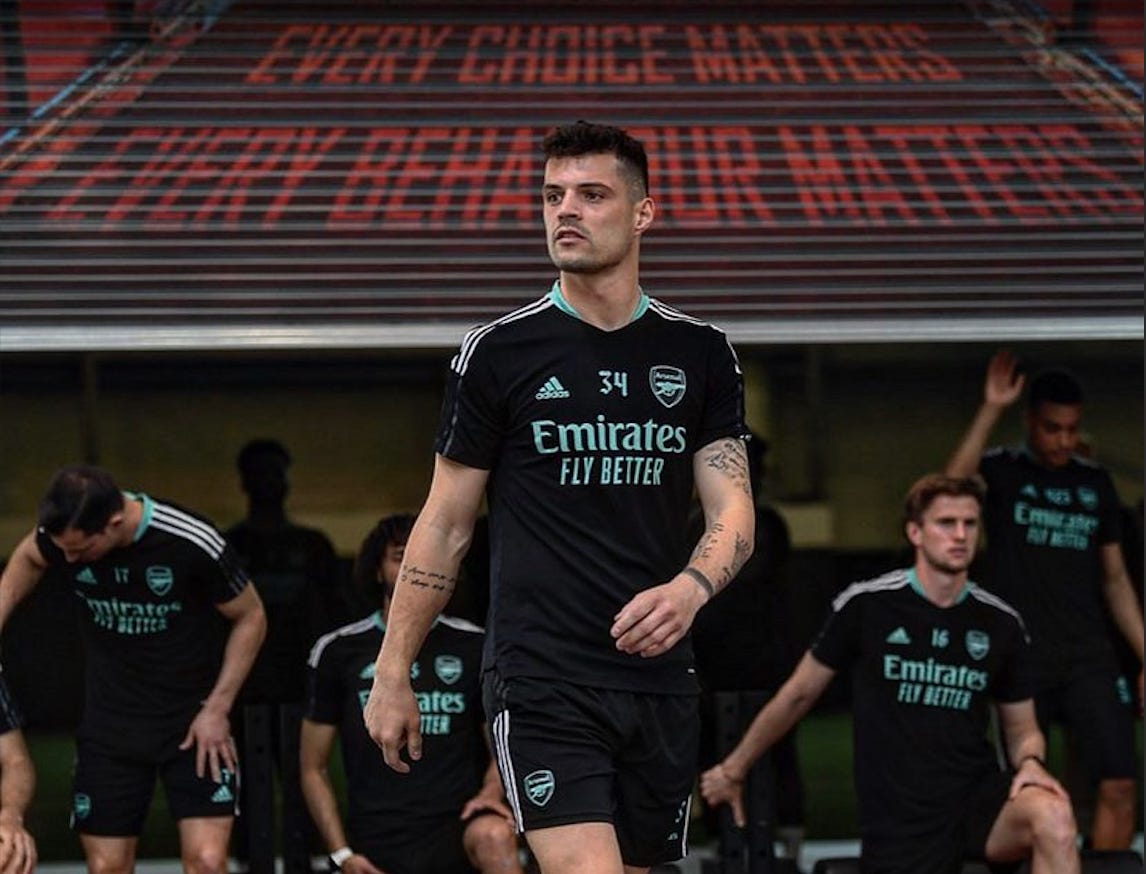
Last week, Granit Xhaka had a piece in The Players Tribune providing what should be the final word on the incident against Crystal Palace in 2019 that led to then Arsenal manager Unai Emery choosing to strip him of the captaincy. It’s a very strongly worded and emotional reflection on why he gave in to the provocation of his own fans and threw his captain’s armband on the ground while walking off the field after being substituted. It’s much more of an explanation than a justification and it ends with Xhaka saying he would like to be much closer to the fans so they can see him for the person he is and not just the footballer.
This is an offer fans should take him up on because Xhaka the man, which is to say the person Xhaka the player morphs into while play is stopped or as soon as his number goes up on the fourth official’s board, is someone who makes the game more interesting. They are inseparable. This is true of all players, but some are much more interesting than others.
Cristiano Ronaldo isn’t especially interesting, for example. He has presented himself as a cyborg for most of his career. His twitter bio is “This Privacy Policy addresses the collection and use of personal information -” and a link to said privacy policy. Even when cracks start to show, like when he slapped a phone out of the hand of a young Everton fan the other day, the apology he released was without question written by several lawyers. When Xhaka released his statement about ripping his shirt and armband off four days later he made it very clear that he was still angry.


From an Arsenal fan’s perspective, I can see how this is not something you feel you should have to endure. It’s all well and good to say the game is better with complex characters, but they’re generally easier to enjoy from a distance. In 1995, when Eric Cantona, in the timeless words of Jonathan Pearce “launched himself six feet into the crowd and kung-fu kicked a supporter who without a shadow of a doubt was giving him lip!” everyone had something to talk about for months, but if you were a Manchester United fan and watched your club miss out on the title to Blackburn Rovers by one point it’s not as easy to say “well the game is richer for these moments.”
My favorite moment of Granit Xhaka’s career came at Euro 2020. He had an excellent tournament with Switzerland. It’s argued that the slower pace and lack of pressing in international football allow him the time and space to control midfield. He’s always been an excellent passer of the ball but never really an elite athlete, which is a relative term in this context.
The Round of 16 saw Switzerland drawn against France in Bucharest. While the Swiss have always been a solid side at the big tournament, France are the current World Cup holders and had a significantly more talented squad. After an outrageous 3-3 draw the game went to penalties and the defining image of the match was Xhaka with a shock of bleached-blonde hair surrounded by his teammates barking instructions and encouragement before the penalty shootout while holding a bottle of Coca-Cola.
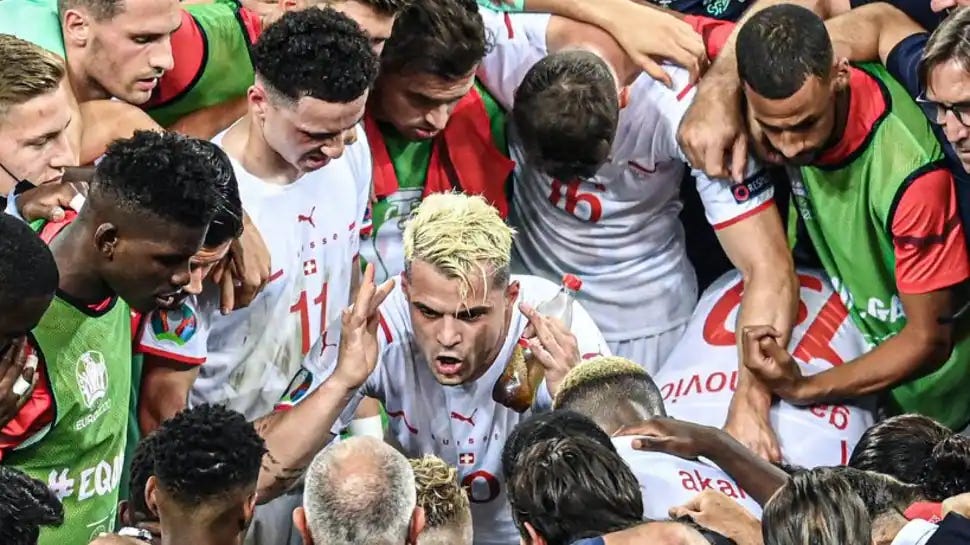
There are understandable reasons for this. I’m sure from a purely scientific perspective, Coke is nothing but fast-absorbing carbohydrates and probably useful for energy after 120 minutes of football. However, it’s a perfect example of the difference in perception of Granit Xhaka between fans and teammates.
You have a player who is thought of as a ill-tempered clown who has totally out of character bleached his hair and is drinking soda during a game against France. You also have a player who has his teammates hanging on every word. An inspiring leader that has been made captain of Borussia Monchengladbach, Arsenal, and Switzerland.
None of this erases the ridiculous red cards or screaming matches with fans, but it’s what Xhaka means when he talks about respect. Everyone is more than their lowest moments on or off the pitch and fans must learn to respect players who, no matter their faults, are human first and footballers second.